


2021-12-01
Leading Universities Across Three Continents Choose Composite Group as Partner for Developing International Composite Materials Standards
Russian company initiated research projects with Harbin Institute of Technology, CSIR-SERC, Unisinos University, and institutes in Singapore and Malaysia
Moscow – Harbin – Chennai – Singapore – Kuala Lumpur – São Leopoldo – Composite Group has established strategic partnerships with leading scientific centers across three continents for joint development of regulatory frameworks for composite materials and conducting large-scale research projects. The geography of scientific cooperation spans China, India, Singapore, Malaysia, and Brazil, where the company has already implemented a breakthrough project to create the first national standard for composite rebar in Latin America.
Unifying Idea: From Technologies to International Standards
All university meetings share a common strategic goal – transforming Composite Group's successful Russian experience in composite materials into international scientific and regulatory standards. The company doesn't simply supply equipment but becomes a center of competence, forming a global ecosystem of knowledge in construction composites. Recognition from prestigious academic institutes confirms that Russian technologies are capable of setting the direction for entire industry development at the international level.
Brazil: Latin America's First National Standard
The partnership with Unisinos University (Universidade do Vale do Rio dos Sinos) in Brazil became a benchmark example of successful international scientific and technical cooperation. Unisinos is Brazil's second-best private university with the TECHNOSINOS technology park, twice recognized as the country's best (2010, 2014), uniting 75 companies from 10 countries. The university implements over 400 research projects and ranks 45th among Brazilian engineering universities.
Joint work between Composite Group and Unisinos University led to the creation of Latin America's first national standard (GOST) for composite rebar. The company not only initiated standard development but actively participated in its creation, contributing Russian expertise and technological developments. Results of joint research are regularly published in international scientific journals, and the Brazilian experience is now used as a model for developing similar standards in other countries.
Harbin Institute of Technology: Large-Scale Chinese Partnership
Cooperation with Harbin Institute of Technology (HIT) – one of China's nine leading universities, part of the national "Project 211" and the Class A university list – became landmark for Composite Group. The company team was given a tour of the Harbin campus with demonstrations of advanced laboratory complexes at the construction chemistry institute.
Composite Group specialists presented a report on new technologies in construction composites to leading Chinese scientists. Following the presentation, parties agreed on their commitment to joint work on creating a composite rebar standard for China based on Russian experience. This decision has strategic significance: in 2020, HIT ranked 6th in the world in university rankings for engineering specialties (U.S. News & World Report), and by 2024 rose to 3rd position globally. 11 of the university's disciplines are in the top 1% of the global ESI ranking, including materials science and engineering.
Active resume exchange is currently underway to select the scientific composition of the international research team. Composite Group received an invitation to participate in government funding programs based on the Russian-Chinese funding allocation program, ensuring long-term government-level support for the project.
CSIR-SERC: Partnership with India's National Laboratory
The CSIR Structural Engineering Research Centre (CSIR-SERC) in Chennai is one of India's national laboratories under the Council of Scientific and Industrial Research and is internationally recognized as a leading institution in construction engineering. The center possesses superior testing facilities, and its services are actively used by the central government, state governments, and the country's largest enterprises.
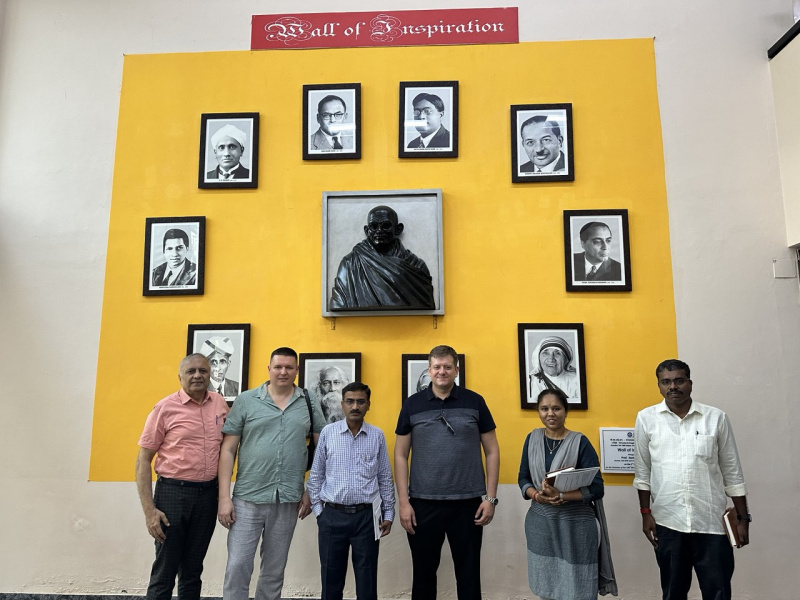
The meeting with the director and scientific leaders of the institute took place in an expanded format. Composite Group representatives delivered a detailed report on construction composites, prospects for their application, and outlined current scientific challenges in this field. The team was given a tour with detailed study of the institute's laboratory testing capabilities.
Following negotiations, Composite Group received an invitation to participate in an international research project. Active correspondence is currently underway to coordinate the terms and format of Russian participation in the research.
Malaysia and Singapore: Tropical Testing and New Standards
The meeting with Malaysian and Singaporean scientists opened prospects for multilateral scientific cooperation in the Southeast Asian region. The Composite Group team visited a testing laboratory for construction materials and reinforced concrete structures, where composite materials testing in tropical climate conditions is planned.
The parties agreed on their commitment to developing regulatory documentation for construction composites in Malaysia, using Composite Group's successful experience in creating standards in Brazil as a baseline model. An agreement was reached to conduct a series of specialized experiments at a Singapore institute to study the impact of intense solar radiation on composite materials – a critically important factor for ensuring structural durability in equatorial climates.
Partners also agreed to participate in an ambitious international research project on statistical validation of hypotheses about testing finished products by secondary indicators, which could represent a methodological breakthrough in industry quality control practices for composite materials.
Forming a Global Ecosystem of Composite Technologies
Composite Group's strategy for creating an international network of academic partners demonstrates a systematic approach to developing the composite materials industry. The company doesn't simply export equipment but builds a global knowledge ecosystem, uniting leading scientific centers across four continents – from Brazil's second-best private university and the world's top-3 engineering university in China to India's national laboratories and Southeast Asian research institutes.
Such cooperation addresses a key challenge of modern construction – creating a regulatory framework for mass implementation of innovative materials that reduce environmental impact, increase structural service life, and improve production efficiency. Composite Group's participation in developing national standards in Brazil, India, China, and Malaysia allows not only to scale Russian technologies but also to shape global industry practices, confirming the leadership of the Russian engineering school on the international stage.


See also